Winter Games I
A new mini-series, wherein the plan is to pop in here, time to time, during the next 10 days—not sure how regularly—with memories of Sarajevo, Salt Lake, Calgary, et al. We'll start at Lake Placid.

Lake Placid 1980 was my first Olympics with any kind of credential. When I say “any kind of,” believe me: My credential, issued last minute not by the IOC (International Olympic Committee) but by, I think, a new colleague at Sports Illustrated who possessed some cardboard and a weighted pen . . . My first credentialed Olympics is not certified by a real, authentic credential. As we shall see.
Placid was my first “working” Olympics, technically, but not my first Olympics in the flesh. That would have been at Montreal in the summer of 1976. I had graduated college in ’75, had enjoyed my “Dugout Year” at B.U. Journalism School — the year described here a couple of Substack posts ago — and in the summer o’ ’76, was lollygagging our Bicentennial away with a last season as “tennis pro” of the Profile Club in the mountain town of Franconia, New Hampshire. I made occasional runs down to Massachusetts for patriotic parades, parties or Sox games, to see the folks, etc.. I was starting to feel some little pressure to “get on with life.”
(Note: As with my mention of the Dugout in Boston, I described the Profile Club and my summers in Franconia in a posting last year — I think a post that was part of last year’s “Jog” series. I’m going try reasonably hard not to recycle old prose here, but please do understand: These stories are all produced by the same grey-cell-powered generator in my head. The most devoted loyalists among you may well think you’re hearing echoes and sensing redundancies. Please accept this self-plagiarist’s apologies. I know I’m guilty time and again of repeating stories I’m fond of, unfortunately. Our kids call me out: “Heard that one, Dad. Ten times. Anything new?”)
Anyway, I had a buddy at the Profile Club named Ron (he’s a buddy still, at age 70 or so). In 1976, Ron had a beater. (He has a nicer car today; I saw Ron and his wife up near Boston at Christmas, and they filled me in on their two grown boys, both now New Hampshirites.) So, Ron had this beater in Franconia, and the Profile club had a policy of Tuesdays off for its small summer staff. Franconia Village was above the Notch, and according to a Rand McNally map I found in the club’s barn, Saint Johnsbury, Vermont, was right over there — about the width of a thumb away, 15 minutes after you got through Littleton. You hit highway 91 at Saint Johnsbury and, bingo! — or et voila! — an hour and half later you’re eating poutine and drinking Labatt. They say there’s an Olympics on in Montreal. So let’s go.
On the last Monday in July, late-afternoon, Ron and I threw our duffels and sleeping bags into the trunk of Ron’s last-legs Chevy and headed north with something sounding like a hoot and a holler. We staked our claim atop Mont Royale in what had become a vagrant-kids’ crumbum campground. Our generation of American young adults had, by 1976, become were versed in the Woodstock Mode of Temporary Settlement, and had memorized Squatting Rights Rules (and Misrules), which had not yet evolved in sophistication to of the floating Deadhead communes of the ‘80s, which would further refine in the new millenium: grandkids playing outside RVs while granddads in egregious tie-dyed T’s (signed by the band!) grilled mail-order Wagyus on their Webers, then hobbled off to the show. The scene atop Mont Royale was hardly that. It was kids like us, many of us from the States, with backpacks and JanSport mummy bags. The Montreal authorities seemed amenable to the establishment of this new precinct on high. What friendly forces they sent up to police the high ground were cheery about all situations; they might have shared a toke for all I know. As we all now know — in spades — Canadians are much, much nicer about everything than we are about anything. They ice-out no one. This is a point to which I’ll return when I get to the Calgary Olympics in my mini-series this week, but for now: We set up housekeeping on Mont Royale, made some friends, followed them downhill into town to their club of choice (they were savvy veterans, having arrived at Chez Royale Resort on Sunday), caught a few sets by a band we thought terrific, which was fronted by this enormous sweaty blues-rocker we dubbed the French Meat Loaf (Loaf was rising back home, soon enough to seize his Bat Out of Hell moment). After three or four hours on Crescent Street, we trudged back up the mountain, zonked out, rose with the cruel summer sun, packed up, trudged back down and bought some tickets from scalpers. Ron and I had a heck of a time that Monday-Tuesday. We enjoyed ourselves on the mountaintop, in the bars, at the venues, and then we were back at work, bright eyed and bushy tailed, on Wednesday morning, having cruised through Customs in the creaky Chevy. You could cruise through Customs back then, even in a beater; you could banter with the Border Patrol in those days. “Seen any suspicious Vermonters, mate? Ha!” This is true, children: You could banter cordially with border guards and be unafraid of winding up in Guantanamo. Also believe this, my young ones: On the streets of Montreal, people seemed to like us. Not me and Ron particularly, but Us, all of us visitors, all of us Americans. We were okay with them. We all joked and smiled and shared our review of the newish Saturday Night Live (it used to be funny show, my children. This is true, too.). SCTV hadn't launched yet — oh! Dear, dear Catherine O’Hara, we miss her so — but we American and Canadian kids all liked Belushi and Ackroyd and Radner and Murray and each other, and described to one another our favorite skits — not a gag lost in translation.
I know Ron and I saw Dwight Stones jump at the track in an afternoon preliminary, and I knew who Klaus Dibiasi was, so we made sure to see him dive, also in a prelim. We noticed a tall, teenaged, Greek God-like American kid dive in the bargain, and learned his name was Greg Louganis. I’d later see Louganis win triumphantly outdoors in the California sunshine in ‘84 at the L.A. Games, then smack his head on the board and bleed into the indoor pool in Seoul in ‘88, but these incidents, like any further Montreal Olympics stories, took place during Summer Games, and I want to stick with the Winter Games in this little mini-series. Let’s move on.
*********
I was still in New Hampshire by 1979, working in Concord, for New Hampshire Profiles in what I can now say was my first real job in what unfolded as “my career.” Having never heard the word chutzpah, I nevertheless had some, apparently, because I took my first, boldest shot, and addressed an envelope, which contained a letter and a few clips, to Mr. Gil Rogin in the Time & LIFE Building, No. 1271 on the grandiosely named Avenue of the Americas. Mr. Rogin’s name sat atop the SI masthead. He was listed as “Managing Editor” and I was curious as to why he wasn’t called “Editor-in-Chief,” but then I was not only innocent of Time Inc. procedures, I didn’t know SI was owned by something bigger than its big self. I didn’t know anything about Henry Luce. I certainly didn’t know a thing about the designations Luce had allowed the bosses of his company’s several magazines, Time, LIFE, Fortune, SI, Money and the precocious five-year-old People among them. They had to be Managing Editors because Luce himself was Editor Chiefest of All he Surveyed.
But Mr. Rogin’s name was highest on SI’s totem pole of names as listed in the magazine, and I figured he was in charge. I addressed the manila envelope to him and affixed more than a half-dozen Old Man of the Mountain U.S. stamps to it.
Gil was, as it turned out, very much in charge. I do not know to this day — I’m astonished I never asked Gil — whether Gil himself had opened my package, maybe announcing to any within earshot that he was “going to the can,” then picking up papers from his desk to read there or edit with his always-at-hand red pencil. As to working in the commode: Gil was routinely brilliant but very much sine qua non (delicate phrasing, that). When staffers were talking among themselves, referencing Gil appreciatively rather than angrily, their summary was, “Well, Gil is Gil.” I did like and was constantly amazed as well as amused by the boss. His many predilections and my loyalty to, and even affection for, Gil were recounted in a Substack post of two years ago entitled “Gil at the Olympics,” which has to do with L.A. in 1984, which was, of course, another Summer Games — as L.A. 2028 will be in two years’ time.
Quickly on my mailing: I don’t know if Gil read it first, second or 10th, but I know he read it because during my interview for a job he referenced a piece in it — “that ski-marathon story wasn't shitty.” What I remember as well is, it wasn’t Gil but Chrissie Walford who had contacted me by telephone in my Concord, NH, office. Might I, she asked, be in New York City anytime soon for any reason? If so, could I drop by to chat with Mr. Rogin? I told Ms. Walford, who I did not know was SI’s Chief of Reporters, that I had no immediate plans to be in Manhattan but could make some. She said fine, and Sunday evenings are best. I said only to myself, “What the f—?”. I hadn’t divined that SI ran on a screwy workweek so that it could cover each weekend’s big contests. In such a week, Sunday night represents all-hands-on-deck crunch time: the factory running at full-throttle on the 20 Floor.
My interview was probably slated for Labor Day weekend. Our Profiles staff was so small, it was hard for me to take time off. With Labor Day, I’d have the Monday holiday. That Sunday night, the lobby of 1271 Avenue of the Americas in midtown Manhattan was semi-dark — it was 8 p.m. or so on the Sunday of a long weekend when the rest of workaday New York was in the Hamptons or at the Jersey Shore. There was only one uniformed person handling the check-in desk. He gave me a pass, said “twenty” and pointed to the second elevator bank. I talked in Gil’s office with him and his Palace Guard of editors. I was wearing my one good pair of slack; the editors were wearing Sunday night work clothing, mostly jeans and chinos. I sensed, at about an hour in, things were going pretty well. I guess they were because Gil eventually asked, “Why the fuck do you want to come down here? New Hampshire’s nice. Lakes. Swimming. Skiing. Seems you’ve got a good job.” Now, in college the f-word or its adjectival and adverbial variants enjoyed every-other-word frequency every minute for four straight years, but I hadn’t heard an adult use it in public, certainly never addressed to me, in maybe . . . like . . . forever? Well, Gil is Gil. I would learn.
I did have a good job, as Gil suggested, but I took this new one. Metaphorically, I was walking one flight of down to a floor that would eventually lead to an Up escalator, a thing you couldn’t readily access from New Hampshire. Chrissie Walford and I agreed I should and would finish the year with Profiles, then report for duty as a reporter/fact checker in her department on Monday morning, January 3, 1980. This I did. I was wearing the only suit I owned, bought on Clearance at Marshall’s in Chelmsford, Massachusetts. I sat on the grey carpet of a 20th floor hallway in the Time & LIFE Building — in the dark, alone — for two or three hours. I had brought nothing to read, and didn’t know the AP ticker was right over there, near the water cooler. That would have been a great find: would have given me something to do. Anyway, the point is: In New Hampshire, everyone reported for work on Monday at 8 if not 7. At Sports Illustrated on Monday, after the Big Sunday Close had finished with its brutal quitting time of 2 or 3 a.m., workers didn’t show up until 10 if not 11. Monday was Friday; Tuesday and Wednesday were the weekend. You’ll get it. Welcome to your new world.
*******
I learned the intricacies of fact-checking my first couple of days, then was handed real copy that real sports fans would read on real pages in four or five days. I started making my checkmarks on the copy. I’ve always enjoyed research and reporting — they’re easier than writing or editing — and I immediately relished the work. I didn’t f-up those first stories, it seems, because maybe on about January 17th — I’m guessing two weeks into the job — think about that: just two weeks! — my phone beeped and it was Chrissie. She was calling from her office, four door down. “You’re from New Hampshire, yes?”
“Actually Massachusetts. I was in New Hampshire when you called about the interview and . . .”
“So you ski?”
“Well, yes, I love to ski.”
“I’ll call you back.”
She did, and said, “Could you call Travel and make arrangements to be in Lake Placid in, say, three weeks from today?”
“Sure,” I said.
Among the things I knew were: 1) This was extraordinary; 2) Chrissie was a little loopy, like my new friends in the reporters’ Bullpen had told me; and 3) There was an Olympics getting under way in this “Lake Placid” upstate somewhere in just under a month.
What I didn’t know was: 1) What was “Travel”? 2) How did one make arrangements with “Travel”? 3) Why was I supposed to be going to Lake Placid? 4) Should I ask someone in particular, one of my colleagues maybe, what the f’s up? 5) Is this the way things always happen at Sports Illustrated?
Interestingly, I was to learn during the next twelve years that the answer to the fifth question was, “No. Not always. But, y’know, actually: often enough.” The sudden “inspiration” and/or whimsy of superior editors at the magazine would, before I moved to LIFE in 1993, send me off to northern Canada to cover a caribou carnage, Northern Alaska to report on oil leases on sacred land, St. Moritz to cover a no-one-else-cares bobsled race, a week of golfing-without-deadline in Ireland, a four-month posting in London, a full year in Sydney to test launch Sports Illustrated Australia. What a great gig I’d stumbled upon.
Travel’s name was, for me, Ralph. He too was a new fellow in Time Inc. Edit. His department was a full-service agency of , which perhaps 15 or 20 agents serving all of the magazines. They worked on a floor I visited in person maybe once or twice in 40 years. I would “be with Ralph” for all 40. I was one of his clients, and he became a friend, even though I most often saw him in person only during lunchtime in the cafeteria, or maybe at the annual blood drive in the auditorium.
I think I’ve written the full version of the next story before now, maybe even here on Substack, so I won’t again. It’s how I didn’t have a credit card (didn’t need one in New Hampshire, really, and I preferred to deal in cash-flow so I with my meager salary wouldn't find myself in, as they say, arrears. However, now, without a credit card, I couldn’t rent a car to drive to Lake Placid, nor check in at the SI encampment at the designated motel on the Placid outskirts (Frank Deford and other hotshots were at the Lake Placid Inn or some hotshot place) — I’ve written about that and how Ralph held my hand as I got a card and a car and was on my way.
As I wheeled up the New York Throughway, Rand McNally riding shotgun, I marveled that this was the newest automobile I’d ever driven in my life. Dad had always bought his used Caddies and Olds-es and Chevys for himself and Mom from his friend Johnny Costello’s 1400 Motors in Lowell; Johnny would call Artie Sullivan when something his boyhood pal might like came on the lot. But this here Avis midsize cruised right along, with a well-working heater and FM as well as AM. Wow. Welcome to the big leagues, kid.
I had never been to Lake Placid. But being a huge fan of New Hampshire’s rugged Cannon Mountain and Wildcat, Vermont’s Stowe and Mad River Glen, I had heard of Whiteface Mountain, certainly — “Iceface,” by reputation. I’d never skied it, but it was right there in the category of hills I’d known. So I didn't feel like I was driving into some scarily foreign place.
The first thing I registered about Lake Placid Village was that it was not huge. It reminded me of North Conway, New Hampshire, or maybe Stowe without the chi-chi and the von Trapps. I liked it — it did feel like home — but I very quickly realized, boy, how are they squeezing an Olympics in here?
Well, we now know that was the last time they even tried to do so. Lake Placid, which had also hosted the Games back in the pioneering days of 1932, lives now in Olympic lore as “the last village Games.” Ever since Sarajevo, the Games headquarter in cities such as Salt Lake or Milan or Pyeongchang, and the events are all hither and thither in the hills beyond. The Alpine skiers and sledders in Italy didn’t go to town for the Opening Ceremonies, they stayed up in the Sudtirol, which used to belong to Austria, not Italy. In Lake Placid, by contrast, everyone was together. Whiteface was right up the road. Things were cozy, warm by the fire — when they weren’t, during the Games, stuck in traffic on two-lane roads.
I checked in to a low-slung building that I’m sure is the destination of an army of guys in camo during hunting season. This was the motel that SI had contracted with for maybe a dozen rooms. I threw my duffel on the bed and laid out my notebooks, pens and portable typewriter on the desktop. I was to be in Lake Placid for four days or so. I thought I was to pitch in with “Bill” — William Oscar Johnson — should he need help with his skiing coverage; after all, Chrissie had led with “Do you ski?” I figured a couple of days of that, then drive five hours back to NYC and help close the magazine over the weekend.
I remember precious little of my first Olympics for SI beyond the briefing I was given when I hit town by Anita Verschoth. Chrissie had told me only, “Check in with Anita when you get up there. She’ll tell you what to do. She’ll give you your credential and tell you what’s needed.”
“Great,” I said the Chrissie. To myself I asked, “Who’s Anita?”
Anita was to the Whole Wide World’s Olympic Movement what our Bill Johnson (not the subsequent downhiller Bill Johnson of the Sarajevo Games, whose temporary co-opting of the name was deeply resented by our Bill Johnson, a man of id and ego) . . . Anita was the Olympics as a whole what Bill was to Alpine skiing, what Bob Ottum was becoming to figure skating, what E.M. Swift (Eddie or Swiftie to us) would soon be to Olympic ice hockey, after we beat the Russkies in the Miracle of Ice and Swiftie wrote the story while Heinz took the famous pictures. Anita at SI was Olympics every day, 12 months a year, year in and year out. Even Dan Jenkins was one of a few on golf, and Dr. Z was one of several on the NFL assignment sheet. Anita was One of One. By the time I met her inn January 1980, she had already worked every Olympics since 1966 for SI, and she would continue to work the Games till century’s end. In a day before FanDual, she was the person who made the medal picks in our Winter and Summer Games preview issues.
While I was with the magazine in the 1980s, Julia Lamb became our Winter Olympics Senior Editor in charge on-site, our quadrennial Chef de Mission. Julie was the face of our operation in whatever corner of the Press Center we owned, and hers was the thankless task of answering the phone calls when Gil hailed from New York: “What the fuck are you people doing there, anyway?” Julie was a terrific editor and leader; Anita was not only her crucial right hand, she was the one who made the trains run — made the operations work — as SI dealt with all matters Olympic during the magazine’s glory years. I can’t emphasize this enough. As I became part of the tight Winter Games SI team in the 1980s (Julie, Bill, Bob, Eddie, guest appearances by Frank, maybe, and then me; and also the much larger all-hands-on-deck Summer Games team; the question I asked most regularly was, “Where’s Anita? I need to ask Anita . . .” As I developed a sideline beat in “Investigations” at SI, of course the Olympics movement was, like the NCAA, an entity needing constant investigation — money, dope, terrorism, dope, scoring irregularities, dope, public pissing, state-ordered doping by the Commies, street dope infiltrating the Village, sexual harassment and worse, dope, dope, more dope. With all the investigating, I began to be seen as a mini-Anita, and got sent to USOC annual meetings and such. But a mini-Anita might as well have been a Mike Meyers comic invention: There was only one Anita, and believe me, they knew and feared here even in Lausanne.
Among colleagues Anita was generous with her information, her advice, her sources. She told me Canada’s delegate to the IOC, the lawyer Dick Pound, was smart, principled, ethical and would talk about anything on background: “Here’s his number.” I called Dick at home for a decade. “Hey Dick, Anita said you might. . .” Anyway . . . . That was Anita.
I found her at the hotel and she welcomed me to the team of reporters. I told her I was supposed to help Bill with the skiing — maybe do some interviews and type up notes for him? “I dunno exactly what I’m supposed to be doing.”
Anita smiled. Business as usual. She said, “Bill usually has things covered. I’m sure he’s got what he needs already. But I’ll introduce you. We’ll see.”
“Do I need a credential?”
“Well, those were issued a long time ago by the IOC. Let’s see what we can do.” She made me some credentials herself, and I realized that if I were challenged by anyone as to their, or if I wasn’t moving within an SI phalanx at an event or venue, then I should just say, “Call SI in the Press office and ask for Julie or Anita.” We were riding high and would soon ride higher, and we had to fight the unseemly arrogance that attends good fortune.
“Right. Will do. Call Anita.”
Anita perhaps fashioned a cred or two for me to try, and we worked some others up at the Press Office, maybe one or two of them looking semi-official.
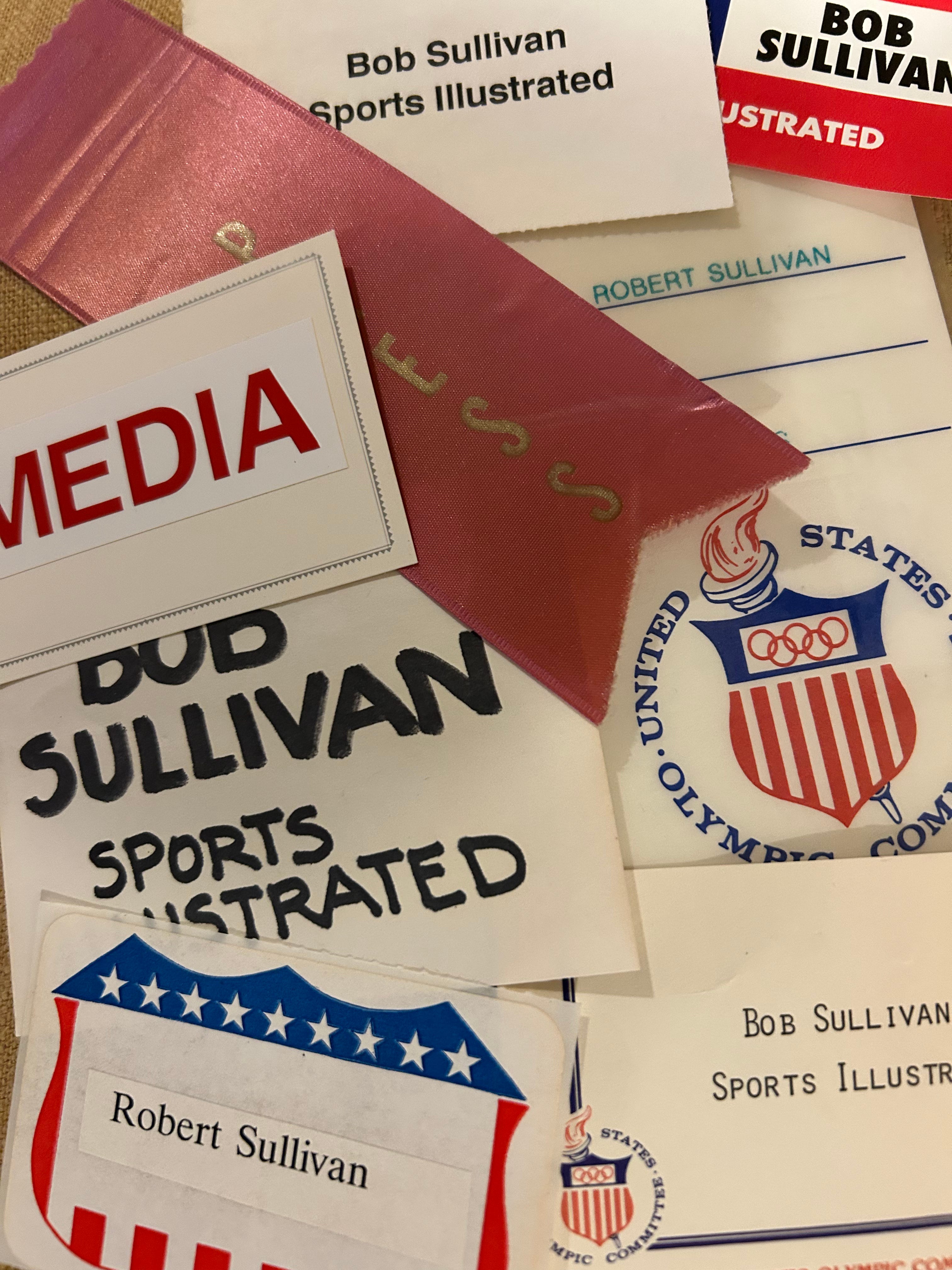
In the photo I made to accompany this post, you can see a certain schizophrenia at work that I’ve lived with to this very day. Beginning at New Hampshire Profiles in the later 1970s, I’d decided to go with an alter ego, an ink-stained doppelganger — Robert Sullivan, on the page. I would still be Bob or Sully when walking around in sneakers, but at the keyboard I would don the Robert cloak for warmth. Maybe if I approached blank pages with “Robert” in mind, I’d think in a more writerly way? I know I know I know: It’s somewhere between silly and ridiculous, a fine line between, in the David St. Hubbins formulation, “stupid, and clever.” But there you go, and all these years later I have written proofs of the very moment that I introduced my two selves to Sports Illustrated — I see the metamorphosing self in these fake I.D.’s.
One day years later, I asked Bob Boyle in the hall how he’d decided on Robert as a byline, and he said because that was what his mom had named him. I liked his thinking and have used that as the story, too, ever since.
I have no idea what I did in Lake Placid for four days besides walk around and thrill to a sense of Being There. You get that when you settle in at an Olympics, particularly a Winter Olympics, and particularly if a snowstorm sets in: a feeling of being isolated in a place, being a part of a community and apart as a community, apart in the world from the world. The world is watching you on TV, perhaps, but TV images are as foreign to you as . . . Well, I don’t have the metaphor, but you are just, for your duration, apart — and if you’re filing a story from your world apart, you’re filing it back to the folks in that other world, to let them know what it’s like in this one.
I did talk to some athletes in Lake Placid and type some things up and give them to this Senior Writer or that one. Athletes might just be walking around in Lake Placid; every other fit-looking person you saw might be an athlete. You knew them from their team jackets, but even if they weren’t wearing the colors, you knew them from their style, stride and enthusiasm.
As I strolled, not producing anything that would be of much use, the thought arose for the first but not the last time, and I smiled as I mulled it: “Man, this magazine will shoot money away for no reason. It must be rolling in the dough. A kid shows up, doesn’t mess up for a week, and then gets a car and a room and he’s at the Olympics because he’s from New England and maybe skis! How great is that?”
At New Hampshire Profiles, we had used any scrap for scratch paper. We sharpened pencils down to the nub. We bought our own coffee. We would never think of “putting in for gas” when driving over the hills to interview Governor Mel Thomson in Orford or old Governor Sherm Adams in Lincoln or maybe the ski champ of Squaw Valley Penny Pitou in Laconia. But now! Here’s this Time Inc., and I show up in Lake Placid and no one really knows what I’m here for, but they’re unsurprised that I’m, and seem happy to see me.
I got to know Bill, Bob and Eddie as well as Anita and Julie pretty well in just a few days, and felt accepted by them. I got zero assignments. I don’t think I saw any competitions. Maybe some x-c skiing. I did go to the Opening Ceremony. What had been the Olympic Stadium in 1932 was too small to accommodate the 30,000 people expected to attend the torch-lighting, so it was being re-purposed as the outdoor speed-skating venue. That icy oval in 1980 was, incidentally, where the Great Heiden would go five for five — and on ice outdoors in all weathers! The New Heiden, 21-year-old Jordan Stolz, just reached two-for-his-first-two this morning, I saw, and may go four-for-four: best-ever since the Old Heiden, who’s over in Milan himself to watch the action. I saw a picture of him explaining things to Snoop Dog.
How very cool it is that both Old and New Heidens practiced their world-beating skills on an oval in West Allis, Wisconsin. Both the GOAT and The GOAT besides the forever GOAT are from the same neck of the world’s speed-skating woods!
Back to Lake Placid for our kicker:
There was, in Lake Placid. a large equestrian facility whose outdoor show-ground was usually snoozing in winter under a blanket of snow. For 1980’s Winter Games, local organizers erected a large-enough temporary stadium. I remember walking quite a ways with my SI teammates to reach the venue, and I was frozen head to toe by the time we reached our section in the bleachers. Then the athletes came in team by team.
There were just over a thousand of them from 37 nations, in a roughly three-to-one ratio of men-to-women. They were there to compete in six sports (38 disciplines). Consider: In the ongoing Games in Italy, there are nearly three times as many athletes from 92 nations vying in eight sports, nearly 50-50 men and women, with all sorts of permutations having been introduced in the popular competitions. Those statistic make absolute sense to me, because I remember standing, shivering, in the stands at Lake Placid, not really caring what in particular was happening below in the ceremony but caring very much that it was, and I was here, somehow, part of this new team in this village apart. I looked around at mountains beyond — so similar to ones I’d known since I was a kid, similar to ones I’d skied. I thought: How cool is this? Those athletes filing in . . . they’re the luckiest people in the world, to be here, doing this.
I, blue with cold up here in this place: I was the luckiest guy in the world.